
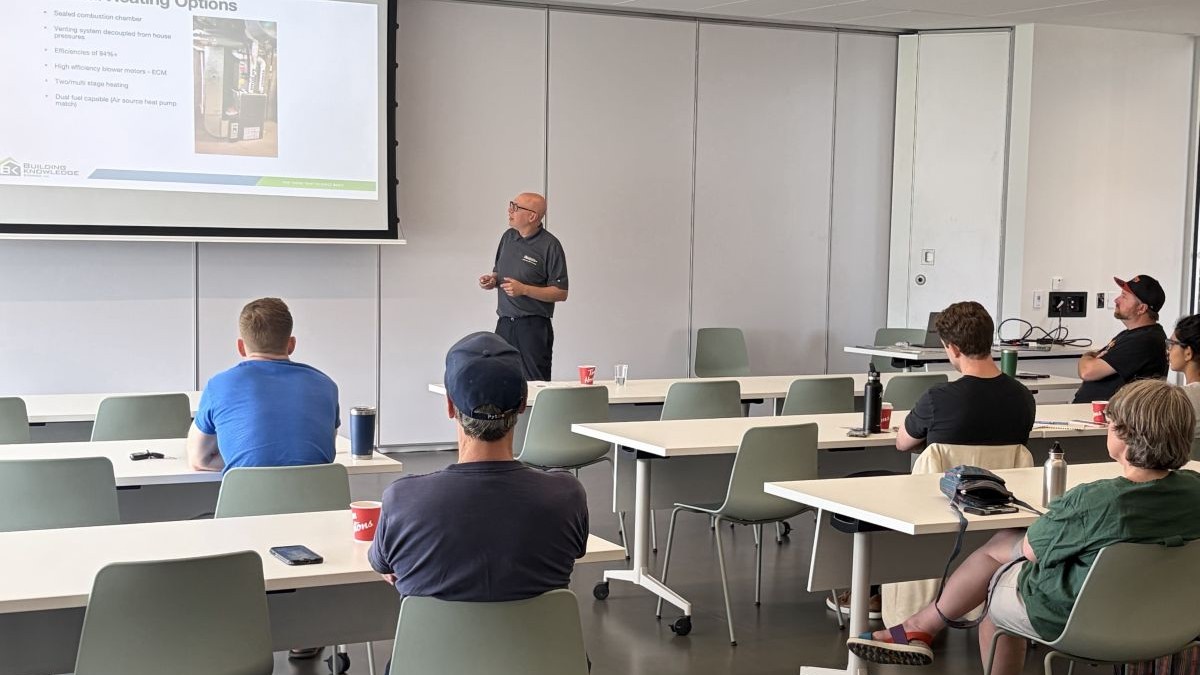
A renovation works best when the whole home is considered, not just one upgrade at a time. In July 2026, Better Homes Peterborough hosted an educational session for local contractors, led by Building Knowledge Canada, that focused on the why and how of building science. Here are five key takeaways, with lessons that both contractors and homeowners should know.
Lesson 1: Your home is more than the sum of its parts
Heating, cooling, ventilation, moisture management, and insulation all work together to create a comfortable, durable and efficient home.
The building science: The cornerstone of building science is looking at a house as a system. This simple but powerful concept has been developed over decades and continues to guide modern energy-efficient construction.
In practice, this means that when you change one part of a home, you affect how other parts perform. Whether you’re installing a heat pump, upgrading insulation, replacing windows, or air sealing your home, every improvement has consequences throughout the building that needs to be considered to get the results you want.
Lesson 2: Moisture control comes first
Water management is not top of mind for many homeowners, but it is a critical part of any renovation to protect your home and your health.
The building science: When water enters a building or moisture accumulates, problems such as mold, wood rot, and early material failure can occur. This can happen anywhere the right materials or techniques are not used. For example, experts at our event highlighted that without the proper window design, flashing and weather barriers, water will become trapped inside the wall instead of draining outward around windows!
Lesson 3: Attics are a top priority
Addressing attic insulation and air leakage together is essential for reducing drafts, lowering utility bills, and preventing moisture-related issues.
The building science: In some cases, upgrading a home’s attic insulation requires additional air sealing to ensure the colder attic space isn’t vulnerable to condensation. The reason is the stack effect. As warm indoor air rises during winter, building scientists call this the stack effect: warm, moist air escapes through leaks in the upper portions of the house while colder air is drawn into lower levels. This process can account for a substantial amount of winter heat loss and can transport moisture into attics and wall cavities where condensation problems may develop.
Lesson 4: Proper heat pump sizing is essential
A high-performing heat pump is only as effective as the design and installation practices that support it.
The building science: With more homeowners considering electrification and heat pumps, experts stressed that every home should undergo proper heat loss calculations before equipment is selected. Oversized systems can reduce efficiency and may even create comfort issues throughout the home. Room-by-room calculations provide contractors with the information needed to ensure equipment is correctly matched to the home’s actual heating and cooling requirements.
Lesson 5: Materials have their own carbon footprint
The renovation process itself always has some environmental impact, but lower-carbon materials help to limit this.
The building science: Most people understand that heating, cooling, and running a home generates greenhouse gas emissions. Within the construction industry, there is a growing awareness of the emissions that are generated when building materials such as insulation and concrete are extracted, manufactured, transported, and installed.
Presenters at our event noted that manufacturers continue to develop lower-carbon alternatives, providing opportunities to reduce environmental impacts while maintaining building performance.
Applying the lessons
The best renovations are those that consider the entire home — a principle that Better Homes Peterborough wholly endorses. By starting with an EnerGuide home energy assessment and continuing with a whole-home approach, homeowners can lower energy costs, protect their homes from moisture, and create healthier, more comfortable living spaces for years to come.
Ready to take the first step? Book a free consultation with our energy coaches to discuss what a whole-home approach could look like for you.